Friday, 13 September 2013

How Do We Ensure That Students Remember What We Teach Them? (Part 2 of 3)

Minimizing the Forgetting Curve and Improving Learner Retention 1

Forgetting, or more correctly minimising the rate at which we forget, is a function of several facets of learning. To maximise retention, your design should:

  •  Ensure the student is engaged by the subject matter.
  • Know what you want the student to remember.
  • Design in-built course motivation.
  • Create cohesive, linked content.
  • Design to use a range of content delivery styles.
  • Provide pre-course preparatory content.
  • Enable discovery learning.
  • Provide effective knowledge checks.
  • Provide post-course performance support content.
I have split the discussion of these solutions over a couple of blogs.

Design learning that is pertinent

You need to make sure that what you teach is pertinent to your students. It sounds obvious, but have you ever been asked to design or write a five-day training course with three or four modules per day? I have, and that means that I am developing a training event on a topic that is defined by the length of time that the customer wants students to be studying. 

As elearning and mlearning begin to dominate the learning landscape, we find that our learning design is more focused on providing the right information, at the right level, at the right time, rather than the amount to fill an arbitrary duration. 

You should develop a course syllabus (let’s call it a course, though I am well aware of the argument that there are no courses any more, just  topics that can be linked together as required) based on the information that you need the students to study. This may mean that a course may be shorter (or longer) than the prescribed length, but it only contains information that is relevant to students. Of course, not all content is relevant to all students, but this exercise should weed out the content that, with the best will in the world, is relevant to no one.


Ensure you know what you want students to remember

Even when we provide training that is pertinent, it is important that we know what we want students to remember. Knowledge workers today are far more comfortable with finding out information, rather than holding it all in their heads (as you can see in this interesting article http://clomedia.com/articles/view/the_new_knowledge_worker_enabling_the_next_generation/print:1) so it is important to identify those elements (if any) that you want them to remember. 

If you are concerned with students retaining information, rather than just knowing that information exists and having a good idea how to find it, you need to identify which information you want them to remember. Do this in discussion with the training stakeholders, but be prepared to challenge them if they say that everything in the course is important and needs to be remembered. If you can gather the core elements that students absolutely need to remember there is a good chance that your design can ensure an acceptable retention rate.

You should note that you may need to provide evidence of this success. This will require some level of post-course assessment. I am not going to cover examinations or tests of this sort here, as they are a function of testing memory, rather than encouraging information retention.


Provide motivation within the training

Reward is one of the oldest motivational stimulus. In the classroom it may be something as simple as praise. We are all motivated by “winning”, as discussed by Jere Brophy in Motivating Students to Learn (Brophy, 2010). You need to understand what winning means for your students, so that you can identify motivational options. The best way to find this out is to ask a sample of the target audience.
Rewards must be linked to the information covered from your training. This may be deductive, where you pose a scenario or ask a question where the student must extrapolate information to deduce a solution, or retentive, where you ask the student to answer a question on the subject matter previously covered. If possible, you should use a variety of approaches. The reward itself can be anything from a simple “well done” to providing additional content or options; a technique widely used in games-based learning.

Behaviourist educational psychologists broadly emphasise motivation based on positive reinforcement from the “teacher” (an external motivation) while constructivists encourage the development of learning content that triggers an internal motivation, where the student congratulates themselves on a job well done. This is a rather basic description, but for us in the practical world, the type of motivation is not as important as the fact that we motivate our students.


Design in-course links

One of the key methods of remembering is by turning single pieces of data into a related map of information. For example, remembering the steps in a process is easier if the student has a context for the process. If you explain a process in the framework of a scenario, the student is more likely to remember the steps. A good scenario, especially one that runs throughout a training event, makes it possible for students to trigger recall of individual details by remembering the overall story. This is the basic philosophy of memory maps, as discussed in Tony Buzan’s Use Both Sides of Your Brain (Buzan, 1976). These links also provide the opportunity to revise previously learned information, without obviously going over it again. For self-study, such as elearning and mlearning, any lack of subtlety in revision can cause the student to lose interest and move to the next topic.


Design for Multi-modal, Multi-layered Content

The Learning Pyramid premise may not be completely true, but it has elements that are well worth noting. Passive study is generally not as effective as active learning, with regards to memory. This means that the top four sections (lecture, read, listen and watch demonstration) are less effective than bottom three sections (group discussion, practice, teaching others). However, it doesn’t take much analysis to realise that without the top four any group discussion, practice or teaching will be short lived. The use of multi-layered learning, with the students learning from a subject authority then putting what they have learnt into some sort of practice, offers the information reinforcement to build stronger memories. 

In addition to this, a mix of content styles, when used to reinforce common information, will deliver greater knowledge retention. This being the case, you should design content that offers as wide a range of delivery styles as possible. In classroom scenarios this is done by the instructor or teacher, who varies their delivery by using lecture, visual aids, demonstrations and discussion to explain and explore a topic. They will also encourage collaborative learning, where the students work together, teaching and learning from each other, to enhance the learning process.

In digital learning (elearning, mlearning, and so forth) the designer must incorporate a rich variety of content delivery styles to emulate what the teacher does in the classroom. This can service the preferred learning styles of students and engage students by offering content in different and challenging formats. This may be a video, a hands-on simulation, or even games. The use of social media for collaborative or group learning should also be a standard for all digital learning designers.

How Do We Ensure That Students Remember What We Teach Them? (Part 1 of 3)


Popular Truisms Concerning Memory and Learning - some background

Getting students to remember what we teach them has been a challenge for instructional designers, teachers, and mentors since time began. The whole issue is bound up in the in the science or art of memory. In this blog, I look at a couple of the more widely quoted philosophies of information retention.

Ebbinghaus and the Forgetting Curve

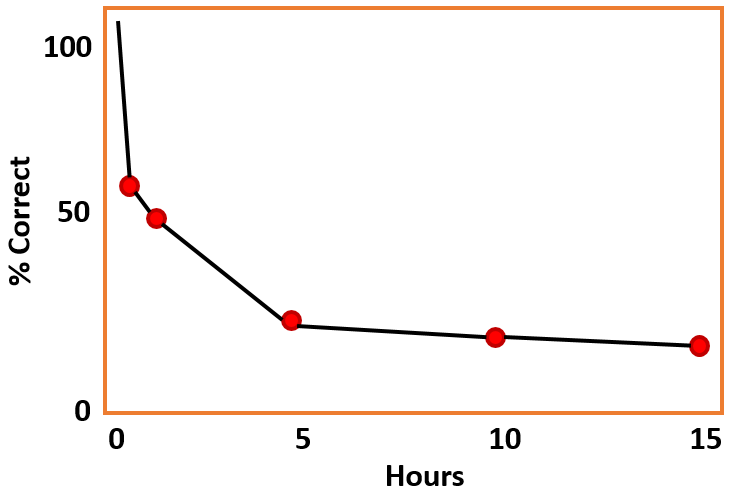
Ever since Hermann Ebbinghaus published Memory: A Contribution to Experimental Psychology (Ebbinghaus, 1885) we have felt able to put a factor on how quickly people forget. The Forgetting Curve diagram, which is essentially based on Ebbinghaus’ study of his own ability to remember, indicates that people forget new information rapidly after they first learn it. This study remained the de facto standard for the best part of a century and is still found across the Internet. There are some fairly basic criticisms of Ebbinghaus’ research methodology, with the obvious one being that his analysis was of himself only—a pretty small test group and one that does not allow for scientific distance. A second, and arguably more telling shortcoming of the research is the fact that he chose to try to remember random letter patterns, which had no meaning or relevance to him, beyond the test itself. Ebbinghaus knew the letters of the alphabet, but the letter patterns had no significance which means that he would be unable to identify patterns, such as words.
This can be seen as a uniquely abstract approach but, when we extrapolate the findings to the real world, it becomes difficult to use as an effective baseline; it is seldom, if ever, the case that we teach something where the students have no previous experience or even terms of reference for the subject matter. By definition, the random, meaningless letter patterns had no relevance to the learner.


The Forgetting Curve Diagram
This, perhaps, explains the almost frightening speed with which Ebbinghaus forgot over 50% of what he had “learned”; a matter of minutes. It has also led to some educationalists to declare that only through constant revision of content is it possible to hold back the Canutesque tide of forgetfulness.

The Learning Pyramid

More widely quoted than the Forgetting Curve, based on a quick Google search, is the Learning Pyramid. This has become something of an urban myth in education and training. It is cited as originating from the National Training Laboratories (NTL) for Applied Behavioral Science, but search their site and there is not even a reference to it. The popular tale is that the research from the 1950s has been lost. No matter. The pyramid proposes that different learning experiences or styles engender different levels of knowledge retention, as shown in the diagram. Students only remember 5% of what they hear in a lecture, 10% of something that they read, and so forth.


The Learning Pyramid
The empirical value of the Learning Pyramid has been questioned—more realistically, discredited—in a number of papers and articles available on the Web, such as Will Thalheimer’s blog Learning Pyramid Debunked (Thalheimer, 2006). I won’t jump on the bandwagon here, but my instinct is to doubt any statistical research that delivers such rounded numbers for a study of a function as complex and nuanced as memory. It appears to be an effort to categorise study options against Edgar Dale's Cone of Experience (Dale, 1946) in an easy to use format; a rule-of-thumb, if you like.

So where does this leave the instructional designer?

With these two popular standards in instructional design called into question, how can we have any hope of helping our students to remember what we teach them? The answer may be by looking at elements of these two, rather than assuming that a study or image that appears across the Internet must be accurate in its entirety.
The beauty of both the Forgetting Curve and the Learning Pyramid is that they are intuitively correct in two areas:

  • Memory Fades. Can you remember all of the information that you have ever known? Unless you have an eidetic memory, the answer is no.
  • Practice Makes Perfect. If you take a car engine apart you will have more experience of taking a car engine apart than someone who hasn’t.

The problem is that since these two statements are so obviously true, that we treat both the curve and the pyramid as truisms. 

Both theories ignore the complexity of the brain and the neurological differences between people. It is also the case that both of these studies assume no, or unrealistically limited, prior experience; Ebbinghaus knew the alphabet but the random nature of the letters meant that this had no bearing on what he was memorising, while the learning curve assumes that only one means of study is used in a learning event. In his defence (not that he needs me to defend him) Ebbinghaus meant this to be the case, but it is very unlikely that you will ever design a course for, or teach, a student who has no understanding of, or even context for, the subject that they are studying. More strikingly, the idea that the best way to learn about successfully dismantling and reassembling an engine is by giving a completely inexperienced person a car and a socket set is laughable (disassembly is easy, putting it back together in working order is the trick). I am sure that anyone who has done any (successful) work on their own car began by doing so under the guidance with someone who had car maintenance experience or by getting hold of a manual; I fondly remember my first Haynes.

If you want to look at some practical solutions to the memory challenge, have a look at my next blog on How Do We Ensure That Students Remember What We Teach Them? (Part 2 of 3)
.

Thursday, 22 August 2013

mlearning—anytime, anywhere is the difference


Mobile learning, or mlearning, has become the must-have training strategy for 21st century education. One of the problems with this migration to mlearning is the number of organisations who are not migrating their learning platform, but are simply migrating their learning content. Doing this misses the whole point—two points to be more accurate—of mlearning; the student can learn anytime, anywhere. 

In our lifetimes the world of learning has escaped from the classroom. Please note that by classroom I mean any place where an individual or group has to be to learn; this may be any classroom, lecture hall or place of work, where an instructor or mentor imparts knowledge, or a room where a student studies an elearning course. All of these are bound by space and often time. The mobile delivery services offered by information and communication technology now means that students can learn whenever and wherever they want. Don’t underestimate this shift. As Mike Sharples puts it in Towards a Theory of Mobile Learning (Sharples, 2005):

“Many theories of learning have been advanced over the 2500 years between Confucius and the present day, but almost all have been predicated on the assumption that learning occurs in a school classroom, mediated by a trained teacher.”

(I have stretched this to include elearning where a teacher is not present, but you get the idea.)

We now have a delivery and consumption paradigm where the student is no longer tethered by time or place; a major change to how we have become used to working. In this blog I will ignore the mechanics of mobile learning design and concentrate on how mobility means that we must change our thinking about our design of training courses and learning events. (If you want to read about mlearning design have a look at my other blogs).

Anytime Learning

Training in industry has become a bit like the summer holiday; there is a set amount of time, we go someplace, we do something, we come back…and (at the risk of stretching the analogy) the tan fades after a few weeks. Many staff regard a training course as a part of the working year. Where there is a necessity for mandatory training, many employers provide some “sheep-dip” compulsory courses, which staff must complete for regulatory compliance. 

There are advantages and disadvantages in these approaches. The idea of going on a training course can put people in the mood for learning, perhaps by changing their environment or putting them with a group of other students with whom they can network and collaborate. On the downside, it takes people out of their workplace for, perhaps, a week and trains them in lots of things that they almost certainly will not use before they have forgotten the training. There is a good deal of speculation regarding how much students retain from a training course. The estimates range from 10% to over 60%, but a lot of the “research” is anecdotal. You can look at both ends of the spectrum by looking at The Low-Hanging Fruit Is Tasty and An Investigation of Training Activities and Transfer of Training in Organizations. Based on no empirical research, I would suggest that the 80:20 rule probably applies to training, just as it does to so much else in life.

What is clear is that we retain things that are pertinent and applicable to our lives. You only stick your finger in a fire once before learning that it hurts; an extreme and very basic example, but true. On a five-day training course you are unlikely to retain all the information that is covered because it almost certainly includes content that will not occur in your working life in the few months following the training event. For example, on an accounting course you may learn lots of information about tax laws, but it is unlikely that you will have to use all of this information before you start to forget the details or they become out-of-date. 

With mlearning the whole classroom model is turned upside-down. The student decides when is the right time for them to study, rather than their having to turn up on a Monday morning at 9am…for coffee and a 9.30 start. Not only do students take control over the starting time, they also control the duration. Received wisdom it that we only concentrate for about 40 minutes on new materials. If a training lesson last for an hour, the last 20 minutes suffer from the law of diminishing returns.
In the business world, where training is regarded as a personal benefit, this empowerment leads to greater engagement for the student and enhance retention for the organisation (Have a look at Jason Silberman’s interesting article in Business News). Students can also ensure that the timing of a training event is pertinent and applicable to their working lives. Our accounting student can spend 30 minutes taking a short course on the facet of tax law that is relevant to their current workload. This can be supported by short refresher content that they can review later, ensuring that what they learned in the initial training is updated for changes or just brought back to mind. Performance Support content of this type enables a student to refresh what they may have learned previously. (It is interesting to note that the Word synonyms for “refresh” include enliven, invigorate, and energise. Isn’t this what we all—student or training designer—want in our training?). This top-up functionality is positioned to improve retention, providing an on-going top-up to avoid the dip in Ebbinghaus’s Forgetting Curve. Although the research that underpins this theory had a questionable methodology, it is clear that memory fades over time, so refreshing learnt information is useful in creating strengthened memories.

Anywhere Learning

In addition to control over when they learn, students can also decide where they learn. With just about all smart devices there is the option to connect via Wi-Fi or across the mobile or cellular phone network to access hosted content that is delivered using Web-based communications technologies. Alternatively a training organisation can develop downloadable apps that provide full course content on the device, with no need to be linked to a central content repository. This approach means that even where there is no communications access a user can still use training materials. For organisations that need to track and manage staff training, the Tin Can API/Experience API initiative enables more flexible, asynchronous learning management.

Many staff commute to and from work on public transport. With the video and audio capabilities of smart devices, it is possible to take a 30 minute course or watch a video on the way to the office. I am not suggesting that this should be regarded as a mandatory learning time, but for users who want to do so, the flexibility of a training app on a smartphone can make this an attractive option.

Is anywhere learning something that students want? (Good question, John) It is estimated that nearly 40% of smartphone users read the news on their devices and 50% search for content or use maps (Smart Insights, Statistics on mobile usage and adoption to inform your mobile marketing strategy). This shows that many people now regard their smart devices as sources of information, rather than just a games-playing diversion.

In addition to anywhere availability of content, the majority of devices offer locale functionality, which can provide geographical context to personal training. For staff working in the health and safety environment of a global business, this means that the organisation can provide training on local H&S practices in their current location. Alternatively, the employee may review some induction training on the local company division. This means that training content can be pertinent, irrespective of location, which is a key element of developing effective and engaging learning materials.

The place of Performance Support content in anywhere learning is well known. In the 1980s staff would lug increasingly bloated Filofaxes with them, packed with the handy hints and tips that they felt might be useful while doing their work. This was particularly the case with mobile workers, like sales executives and on-site engineers. With Performance Support content delivered on mobile devices, all of this can be maintained as a centrally managed set of up-to-date resources that a “student” can use to help them on-the-job. I have put student in quotes there because this is far removed from our student/classroom archetype; this is life-long learning in action.

And in Conclusion…

There is a lot of hype about mlearning, and too often it is driven by training organisations trying to put what they already have into HTML5, so that it can be viewed on an iPhone. Like any training, mlearning needs to be designed to fit the audience and environment. Simply migrating current content can lead to a poor fit and substandard learning. Equally importantly, it misses the opportunities offered by anytime, anywhere learning.